Himalayan vs Crystal Singing Bowls
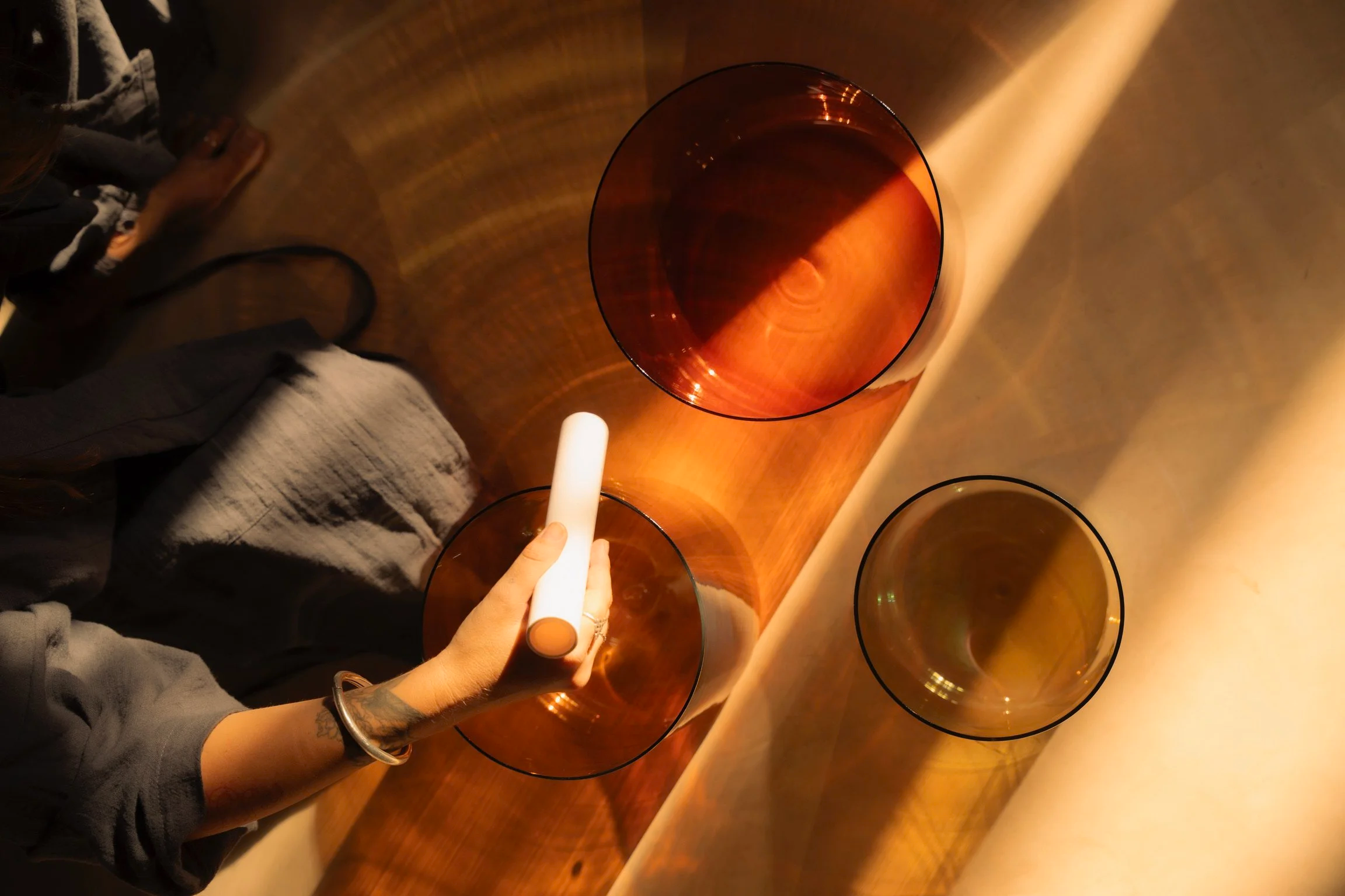
If you're stepping into the world of sound healing, whether as a practitioner in training or someone building their first instrument collection, one question comes up almost immediately:
Tibetan bowls or crystal bowls?
Both are beautiful. Both are powerful. Both are widely used in sound healing practice. But they are very different instruments, with different sounds, different feels, different energetic qualities, and different practical considerations.
This guide will help you understand the difference, so you can make a choice that feels right for where you are and where you're going.
About Himalayan Singing Bowls
Let's start with an honest piece of history, because it matters.
The bowls commonly sold as "Tibetan singing bowls" are more accurately called Himalayan singing bowls. They were made in Nepal by Nepali artisans, hammering metal alloys by hand, and shaped into the bowls seen in the monasteries of Tibet. The name "Tibetan" refers to the people who used them, not the people who made them.
The bowls' popularity for healing through vibrations surged in the early 1990s, around the same time international interest in Tibet increased. The manufacture and use of bowls specifically for "singing" as opposed to standing bells intended to be struck is believed to be a modern phenomenon. Bowls capable of singing began to be imported to the West around the early 1970s.
Today they are commonly used in Tibetan centres to begin and end meditation. The "ancient Tibetan healing tradition" narrative, while romantic, is largely a Western construction. None of this makes the bowls less powerful. It simply means we should hold them with honesty, as extraordinary instruments whose modern use in sound healing is a relatively recent, largely Western development, built on resonance with ancient meditation traditions rather than an unbroken lineage of healing practice.
The bowls work. Thousands of practitioners and participants will tell you that. The science of how sound affects the nervous system supports it. We just think it's important to say clearly what we know and what we don't rather than repeat origin stories that don't hold up to research.
The Sound Itself
What the bowls produce is undeniable. When struck or played with a mallet around the rim, they create a rich, complex, multi-layered sound with many overtones. The sound is warm, earthy, and organic. It has texture and depth. Each bowl has its own unique voice — no two are exactly alike. This complexity is part of what makes them so effective in sound healing practice. The multiple overtones create a broad, enveloping sound field that is deeply settling for the nervous system.
About Crystal Singing Bowls
Crystal singing bowls are made from pure quartz crystal, typically 99.99% silicon quartz, that is ground into a fine powder and fused at extremely high temperatures into a bowl shape.
They come in two main varieties:
Frosted bowls: larger, opaque white bowls with a powerful, sustaining sound that carries across large spaces. These are the most common crystal bowls and what most practitioners start with.
Clear or alchemy bowls: smaller, transparent and often infused with precious metals, gemstones, or minerals during the manufacturing process.
Crystal bowls produce a single, pure, sustained frequency with very clean overtones. The sound is bright, spacious and penetrating. Where Himalayan bowls feel earthy and grounding, crystal bowls feel expansive and ethereal.
The Key Differences
Sound quality
Himalayan bowls produce a complex, layered sound with many overtones: warm, rich, textured & organic. The sound decays relatively quickly, which means you're constantly re-engaging with the instrument.
Crystal bowls produce a pure, clean, sustained tone that can hold for a very long time after being played. The sound is more singular and penetrating.
Neither is better. They create very different sonic environments and many practitioners use both.
Feel and physicality
Himalayan bowls are metal, solid and heavy. They have a tactile warmth. They feel grounded in your hands. Playing them requires physical engagement, you feel the vibration through your palms and fingers.
Crystal bowls are lighter than they look but more fragile. They require careful handling and storage. They need to be treated very gently; a knock against a hard surface can chip or crack them.
Frequency and the body
Both types of bowl affect the nervous system through vibration and sound. Himalayan bowls, with their complex multi-tonal sound, tend to produce a broader, more diffuse field of vibration. Crystal bowls produce a purer, more sustained single tone that many people experience as more expansive and penetrating.
Price
A good quality Himalayan singing bowl can be found for 50–300 CHF depending on size, quality, and origin. A set of 3–5 bowls gives you a working range of frequencies for most situations.
Crystal frosted bowls typically start around 150–400 CHF for a single bowl. Clear crystal bowls can range from 400 to several thousand CHF (Alchemy Bowls) each.
Portability and durability
Himalayan bowls are virtually indestructible. They can travel in a bag, get knocked around, and keep singing. This makes them practical for practitioners who travel frequently or teach in varied settings.
Crystal bowls are more delicate. They need protective cases and careful transport. A frosted bowl dropped on a hard floor may survive, or it may not.
Which Should You Start With?
Start with Himalayan bowls if:
You want versatility and warmth. You travel frequently or teach in varied locations. You're drawn to a more organic, earthy sound. You want to begin without a large investment. You're new to instruments and want something forgiving and durable.
Start with crystal bowls if:
You're drawn to pure frequency work. You plan to work primarily in one fixed location (or smaller sets that you can transport). You want the expansive, ethereal quality that crystal produces. You've already experienced crystal bowls and felt a strong resonance with them. You're interested in layering sounds, using crystal bowls as a sustained drone tone beneath other instruments like harmonium, voice, or chimes, where their long sustain and clean frequency create a beautiful tonal bed for everything else to sit in.
The honest answer for most beginners:
Start with a small set. Once you have a practice and understand what you're looking for in sound, you'll know which bowls call to you and the choice will feel much clearer.
Many experienced practitioners use both Himalayan bowls for grounding and texture, crystal bowls for frequency and expansion. They complement each other beautifully in a sound journey.
What About Other Instruments?
Singing bowls are the foundation of most sound healing practice. But they are far from the only instruments worth knowing. Here are a few more that we love and use in our sound baths:
Gongs produce the most powerful and complex sound field of any instrument in the sound healing palette. A well-played gong can fill an entire room and carry a group into very deep states. They are expensive and require significant skill; most practitioners come to the gong after working with bowls for some time.
Chimes and koshi are beautiful, gentle instruments perfect for opening and closing a sound journey. They are accessible, affordable and deeply loved.
Tuning forks are precise, scientific instruments used for specific frequency applications. They are particularly valued in one-to-one therapeutic settings.
Voice is the most personal, most powerful & most underestimated instrument available to any practitioner. Your voice costs nothing, goes everywhere with you, and can reach places no other instrument can.
Harmonium/ Shruti Box brings a devotional, Bhakti quality to sound work. Deeply beautiful for creating a warm, sustained tonal bed beneath other instruments.
Medicine drums are one of the oldest healing instruments on Earth, used across indigenous traditions worldwide. The rhythmic pulse of a drum is deeply regulating for the nervous system. A drum brings grounding, heartbeat & primal presence into a sound journey in a way no other instrument does.
Hand pans are one of the most beloved instruments in contemporary sound healing: melodic, meditative, instantly transporting. Their warm, resonant tones sit beautifully alongside bowls and voice. They require significant practice to play well but reward that investment deeply. A hand pan in a sound journey creates an almost immediate sense of wonder and stillness in listeners.
Flutes whether Native American style, bansuri, or other traditions — bring breath, air & spaciousness into a sound journey. Where bowls create fullness, a flute opens space. Accessible to begin, endlessly deep to explore.
Guitar is underused in sound healing contexts and worth reconsidering. Open tunings, slide techniques, and sustained chord work can create genuinely hypnotic drone fields. For practitioners who already play, integrating guitar into a sound journey adds warmth, familiarity, and a human quality that more "exotic" instruments sometimes lack. It can be a bridge for participants who find singing bowls unfamiliar, something recognisable that opens the door.
How we choose Instruments at Soulravel
At Soulravel, we have spent years working with instruments from many different makers and regions. Our store carries only instruments we have personally played, tested, and stand behind. Sets curated specifically for practitioners at different stages of their journey.
We offer consultations to help you choose the right instruments for your practice, your budget, and your goals. As a Soulravel training student, you receive 10% off all sets in our store.
If you're unsure where to start, reach out — we're happy to guide you.
The Bottom Line
Tibetan or crystal? Both are extraordinary. Both deserve a place in a practitioner's hands.
But if you're just beginning: start with what calls you. Trust the pull. Pick up a bowl at a market, at a training, at a studio and notice what happens in your body when you play it. The instrument that makes you want to keep playing is the right instrument.
Sound is not about perfection. It is about presence. And the bowl that brings you most into presence is the one you should begin with.
Explore our Instrument Collection
Hand-selected Himalayan and crystal singing bowl sets, chosen by sound practitioners for sound practitioners.
→ Visit our store at soulravel.com/store
→ Join our next Alchemy of Sound training to play a full range of instruments before you buy: soulravel.com/sound-practitioner-training
Written by Natalija & Jonny, founders of Soulravel.